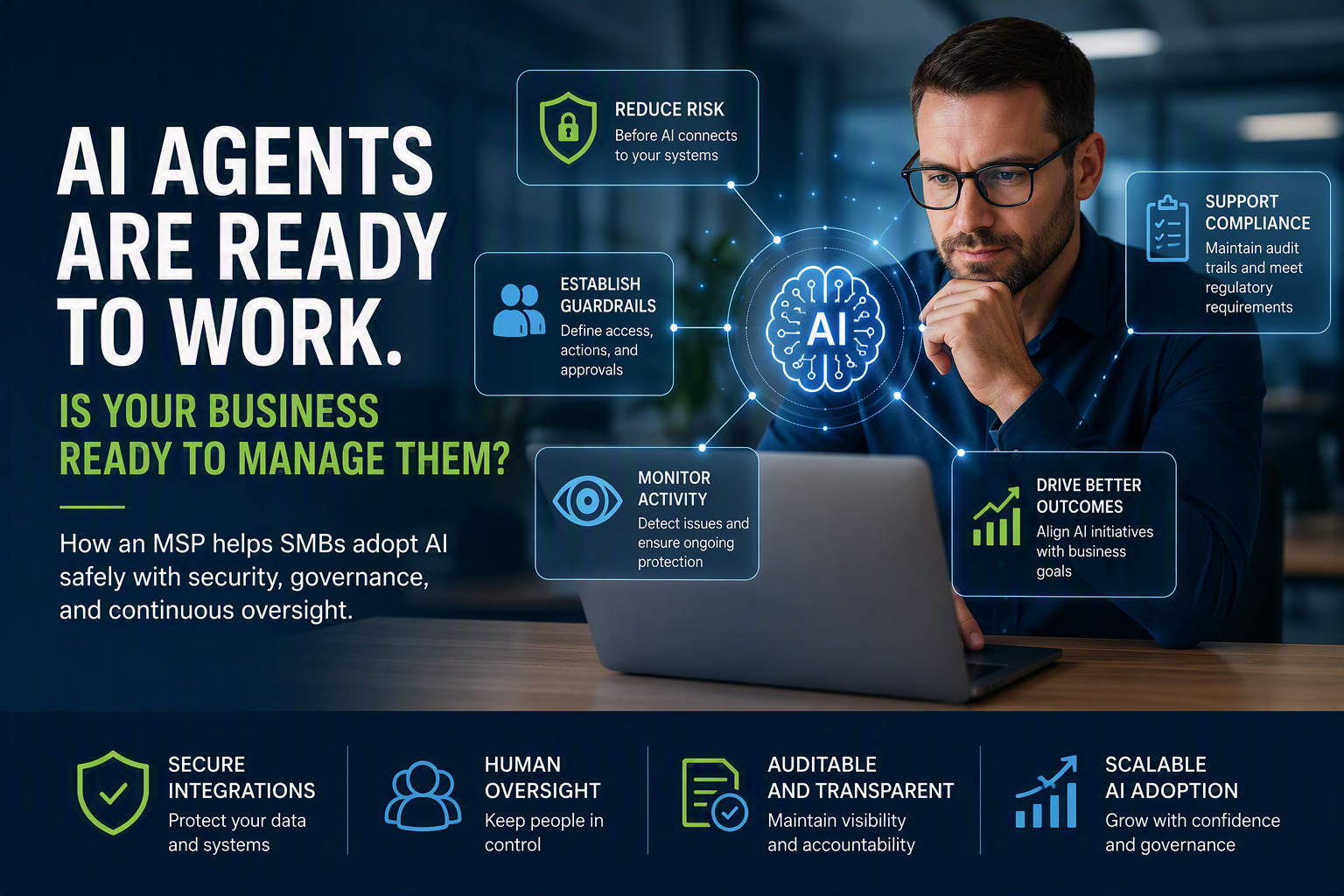
AI Agents Are Ready to Work. Is Your Business Ready to Manage Them?
Artificial intelligence is quickly evolving from a helpful assistant into an active participant in day-to-day business operations.
Today's AI solutions can do more than answer questions or draft content. They can access business systems, retrieve information, update records, create tickets, generate quotes, and automate workflows across multiple applications.
For small and midsize businesses, this creates tremendous opportunities to improve productivity and reduce manual work. It also creates new challenges that many organizations are not prepared to manage alone.
As AI becomes increasingly connected to the systems that run your business, success depends on more than simply deploying new technology. It requires security, governance, oversight, and a clear strategy.
That's where a Managed Services Provider can help.
The Promise of Connected AI
Many businesses are exploring ways to connect AI to:
Customer relationship management (CRM) platforms
Accounting and ERP systems
Ticketing and service desks
Document repositories
Knowledge bases
Industry-specific line-of-business applications
When implemented correctly, these connections allow AI to become more useful and more context-aware.
Instead of simply answering questions, AI can help employees:
Find information faster
Complete repetitive tasks
Improve customer response times
Streamline internal processes
Make better business decisions
The potential benefits are significant.
However, greater access also means greater responsibility.
The Questions Every Business Should Be Asking
Before connecting AI to critical business systems, organizations need to consider several important questions:
What information should AI be allowed to access?
What actions should AI be allowed to perform?
How do we prevent accidental data exposure?
Who monitors AI activity?
How do we ensure compliance requirements are maintained?
What happens when an AI-generated action is incorrect?
These aren't simply technology questions.
They are business risk questions.
Many organizations are surprised to learn that once AI gains access to multiple systems, it may be capable of retrieving, processing, and acting upon information in ways that employees never anticipated.
Without proper controls, businesses risk creating operational, compliance, and security challenges that could outweigh the benefits of automation.
Why SMBs Need More Than an AI Deployment Partner
Deploying AI is relatively easy.
Managing AI responsibly is much harder.
Many organizations can connect AI tools to business systems. Far fewer have the expertise necessary to continuously monitor, secure, govern, and optimize those environments.
This is where an MSP provides ongoing value.
1. Reducing Risk Before Deployment
Before connecting AI to business applications, an MSP can help evaluate:
Security implications
Data access requirements
Permission structures
Compliance concerns
Workflow design
Potential operational risks
Much like a security assessment identifies vulnerabilities before a cyberattack occurs, an AI readiness review helps identify concerns before automation creates unexpected consequences.
The goal is not to slow adoption.
The goal is to ensure adoption happens safely.
2. Establishing Business Guardrails
One of the biggest misconceptions about AI is that every workflow should be fully automated.
In reality, businesses need clear guardrails.
An MSP can help determine:
Which systems AI should access
Which data should remain restricted
When human approval should be required
How sensitive information should be protected
Which activities should be monitored
This creates a balance between productivity and accountability.
AI should accelerate work, not eliminate oversight.
3. Monitoring AI Activity
Most organizations already monitor:
Endpoints
Servers
Firewalls
Email systems
Cloud applications
As AI becomes integrated into business operations, it deserves the same level of attention.
MSPs can help organizations monitor:
Unexpected AI behavior
Changes to integrations
High-risk activities
Data access trends
Workflow anomalies
Security events
Ongoing monitoring helps ensure that AI remains aligned with business objectives while reducing the likelihood of unwanted outcomes.
4. Supporting Compliance and Governance
For many organizations, compliance requirements aren't optional.
Whether operating in healthcare, financial services, nonprofit organizations, professional services, manufacturing, or local government, businesses must maintain appropriate controls around data access and operational processes.
AI introduces new considerations that many compliance programs were never designed to address.
An MSP can help organizations:
Document AI governance practices
Maintain audit trails
Define acceptable use policies
Establish approval workflows
Align AI initiatives with existing compliance requirements
This creates confidence for leadership teams while helping organizations demonstrate responsible use of emerging technologies.
5. Driving Business Outcomes Instead of Technical Projects
One of the most valuable roles of an MSP is helping clients focus on outcomes rather than technology.
The discussion shouldn't start with:
"How do we connect AI?"
It should start with:
"What business problem are we trying to solve?"
Organizations that achieve the most value from AI typically focus on practical use cases such as:
Improving customer service
Reducing administrative work
Accelerating decision-making
Shortening response times
Increasing employee productivity
Technology is simply the tool that enables those outcomes.
An experienced MSP helps ensure AI initiatives remain aligned with business priorities, rather than becoming isolated technology experiments.
The Future of Managed Services Includes AI Governance
As AI capabilities continue to expand, businesses will increasingly need trusted partners who can help them balance innovation with risk management.
The most successful AI projects won't necessarily belong to the organizations with the newest tools.
They'll belong to the organizations with the clearest strategy, strongest governance, and most effective oversight.
That's where managed services can provide lasting value.
Final Thoughts
AI is rapidly becoming part of how businesses operate, communicate, serve customers, and make decisions.
The opportunity is enormous.
But successful adoption requires more than connecting AI to your systems and hoping for the best.
Organizations need guidance, governance, monitoring, and a clear framework for responsible growth.
A Managed Services Provider can help evaluate risks, establish safeguards, monitor activity, and ensure AI remains aligned with your business goals.
Because the real advantage isn't simply adopting AI.
It's adopting AI with confidence