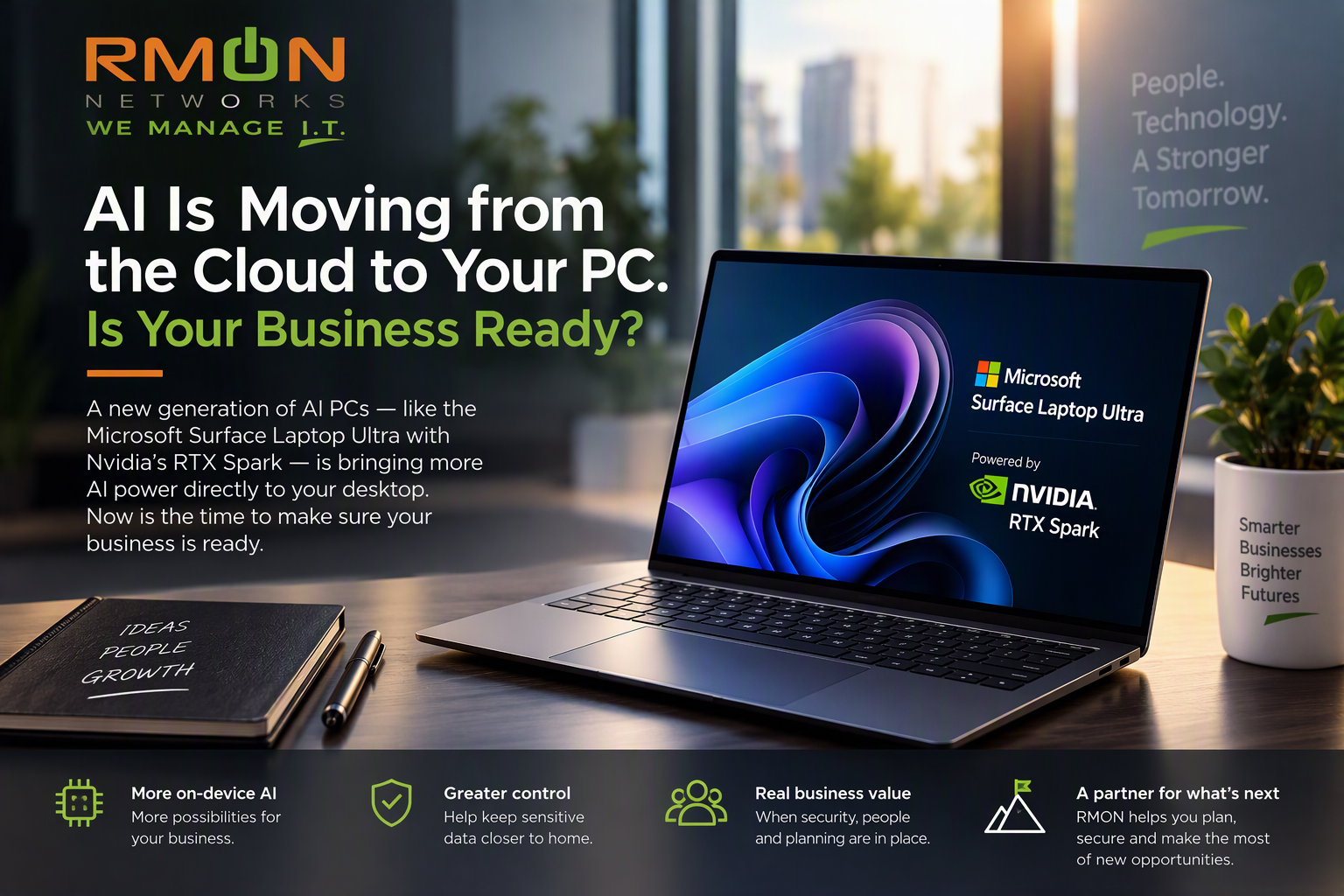
AI Is Moving from the Cloud to Your PC. Is Your Business Ready?
Artificial intelligence is entering its next phase, and it may be happening right on your employees’ desktops.
The recently announced Surface Laptop Ultra from Microsoft and Nvidia is designed specifically for AI workloads, including running sophisticated AI models directly on the device. Microsoft is also introducing a hybrid approach to Copilot that can divide AI processing between the cloud and the local PC.
For small and midsize businesses, however, the real story isn't the new laptop.
It's what this shift could mean for the way businesses plan, secure, and manage their technology.
Why On-Device AI Matters
Most businesses have become accustomed to thinking about AI as a cloud service. You enter a prompt, information is processed elsewhere, and a response comes back.
Increasingly, AI-capable PCs are being designed to perform more of that processing locally. Microsoft points to greater control over data as one benefit of this approach, particularly when information doesn't need to be sent to the cloud for processing.
That creates exciting possibilities, but it also introduces new questions for business leaders:
What information can AI applications access?
Are employees using company data appropriately with AI?
How should AI agents be authenticated and governed?
Do current endpoint security policies account for locally running AI?
Should AI capabilities become part of your next hardware refresh strategy?
These aren't simply technology questions. They're increasingly business, cybersecurity, and data-governance questions.
AI Agents Add Another Layer
Another important development is the rise of AI agents, which can perform activities on behalf of users.
Microsoft emphasized during its announcement that AI agents need identities and permissions that are separate from those of the user. The company is also introducing security technologies intended to isolate autonomous AI agents when they're executing untrusted code.
This points toward an important principle for businesses adopting AI:
AI should not automatically have access to everything an employee can access simply because that employee is using it.
As AI becomes more capable, identity management, permissions, data classification, endpoint protection, and governance become increasingly important parts of an organization's AI strategy.
Don't Start with the AI Tool
At RMON, we believe businesses should approach AI adoption from the foundation up.
Before asking Which AI tool should we buy?, organizations should first ask:
Is our environment ready for AI?
That means understanding:
Your Data
Where is sensitive business information stored, and who currently has access to it?
Your Identity and Permissions
Are employees and applications limited to the information they actually need?
Your Security
Are devices, identities, applications, and company data appropriately protected?
Your Governance
Does your organization have clear expectations around how AI can and cannot be used?
Your People
Do employees understand how to use AI responsibly and where the risks are?
What This Means for Your Next PC Refresh
You probably don't need to replace everyone's laptop tomorrow because a new generation of AI hardware has arrived.
But if your business expects to refresh computers over the next year or two, AI readiness should become part of the conversation.
Instead of evaluating new devices solely on processor speed, memory, storage, and price, businesses should begin considering how their future applications may use AI and what security and governance will need to surround those capabilities.
The RMON Takeaway
AI adoption isn't just about adding Copilot or purchasing AI-enabled PCs.
It's about creating an environment where your organization can take advantage of AI without unnecessarily increasing risk.
The businesses best positioned to benefit from this next wave of technology will be the ones that prepare their data, identities, devices, security, and employees before AI becomes deeply embedded in everyday operations.