Cyber Risk Is Changing. Here’s How SMBs Should Respond.
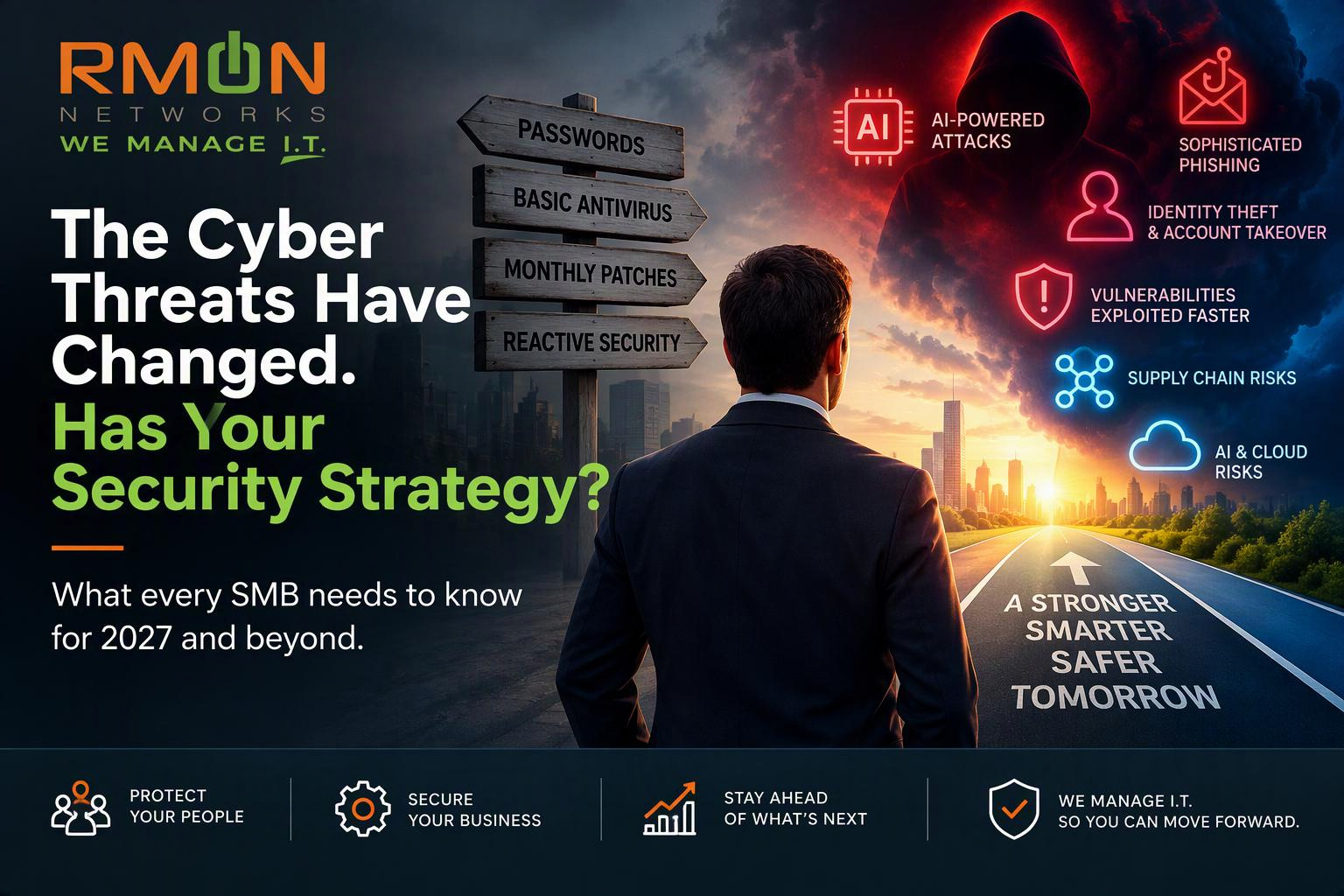
What Microsoft’s 2026 Digital Defense Report Means for Small and Mid-Sized Businesses
For years, cybersecurity advice sounded fairly predictable: use strong passwords, turn on MFA, train employees not to click suspicious links, patch computers, and maintain good backups.
Those things still matter.
But according to Microsoft’s Microsoft Digital Defense Report 2026, the environment around them has changed dramatically. Artificial intelligence is accelerating attacks. Criminals are getting better at impersonating people and businesses we trust. Vulnerabilities can be weaponized faster. And attackers increasingly target legitimate identities, software, vendors, cloud services, and everyday business tools rather than simply trying to sneak malware onto a computer.
For small and mid-sized businesses, the takeaway isn't that cybersecurity has become hopeless.
It's that the definition of being "secure" needs to change.
AI didn't eliminate the old attacks. It put them on fast-forward.
AI gets a tremendous amount of attention in cybersecurity, but one of the most interesting conclusions in Microsoft's report is that many of the attacks themselves aren't necessarily new.
Attackers still steal credentials. They still exploit unpatched systems. They still impersonate trusted people. They still use phishing and social engineering.
AI simply allows them to do it faster, cheaper, and at much greater scale.
Microsoft reports that AI is accelerating everything from vulnerability discovery and reconnaissance to phishing, malware development and attack orchestration. In some cases, stages of an attack that once took days can now happen in minutes.
For an SMB, that changes the security equation.
A firewall that gets patched next month might have once seemed reasonable.
Today, next month may be much too late.
Your employees aren't the only identities attackers want
One of the strongest themes running throughout Microsoft's report is identity.
Once attackers obtain legitimate credentials, tokens or sessions, malicious activity can look remarkably similar to normal activity. The attacker doesn't necessarily need to "break in" anymore.
The attacker can simply sign in.
And the challenge is quickly expanding beyond employees.
Applications, automated workflows, cloud services and AI agents can all have identities and permissions of their own. Microsoft specifically warns about excessive permissions, persistent access and weak governance across both human and non-human identities.
That's why modern identity security needs to include:
Phishing-resistant MFA and passkeys
Least-privilege access
Separate administrative accounts
Strong controls around privileged identities
Monitoring of abnormal sign-ins and account behavior
Management of application, service and AI-agent permissions
There is actually some encouraging news here.
Microsoft reports password attacks fell 26% year over year, which it says provides evidence that controls such as MFA and passkeys are forcing attackers to change tactics.
Security controls do work. Attackers simply adapt.
Phishing doesn't look like phishing anymore
Remember the badly written email promising an inheritance from someone you've never heard of?
That isn't where phishing is headed.
AI allows criminals to create polished, personalized communications that resemble normal business conversations. Attackers are also increasingly exploiting the trusted workflows employees encounter every day.
One Microsoft finding is particularly striking: nearly 85% of reported phishing emails analyzed between April and June 2026 contained an impersonation signal.
The impersonation isn't limited to famous brands.
Attackers mimic:
Coworkers
Executives
HR
Payroll
Vendors
Business partners
IT support
Automated business notifications
Microsoft found that among phishing attacks mimicking an organization's trusted operating environment, HR, payroll and benefits scams represented 77% of those organizational cases.
The lesson for SMBs is important:
A message doesn't have to look suspicious to be dangerous anymore.
Even "Do you have a minute?" can be the beginning of an attack
Microsoft is also encouraging organizations to think beyond traditional Business Email Compromise.
The report uses the term Business Contact Impersonation, or BCI.
Microsoft detected more than 46 million BCI attacks over the preceding 12 months. But here's what's surprising: criminals increasingly aren't asking for money in the first message.
They might simply ask:
Are you at your desk?
Or:
Do you have a moment?
The financial request comes later, after a normal-looking conversation establishes trust.
By June 2026, Microsoft found that only 3% of initial BCI messages contained an explicit financial or document request, down from 17% in October 2025.
Technology alone can't solve that problem.
Businesses need processes requiring employees to independently verify unexpected requests involving payments, payroll changes, credentials or sensitive information.
Trust, but verify, is becoming a cybersecurity control.
The phone call from "IT" deserves a second look too
Email isn't the only concern.
Microsoft says confirmed malicious cross-tenant vishing activity in Microsoft Teams increased 502% year over year, and over 90% of attackers using Teams incorporated voice calls into at least some attacks.
Consider how effective that could be inside a busy SMB.
Someone calls through Teams and appears to be technical support. There is a computer problem. The caller walks the employee through installing a legitimate remote-support application.
Nothing necessarily looks like malware because the attacker may be using the same types of remote access tools legitimate IT providers use.
Microsoft recommends restricting remote management tools to authorized IT groups and combining endpoint detection, external-user warnings and monitoring for suspicious activity following external Teams calls.
For employees, the policy should be even simpler:
If someone unexpectedly contacts you claiming to be IT support, verify that person through your normal support channel before granting access.
Yesterday's PDF attachment is today's phishing tool
Here's another change business owners should know about.
PDFs are becoming a favored delivery mechanism for phishing.
Microsoft detected more than 145 million QR-code phishing attacks between July 2025 and June 2026, and PDFs eventually became the dominant delivery vehicle for many of those attacks. Microsoft also detected more than 100 million phishing attacks using CAPTCHA pages during that same reporting period.
Why does this work?
Imagine this sequence:
Email → PDF → QR code → personal phone → fake Microsoft 365 login
The attack has now moved from the corporate email system and managed computer onto an employee's phone.
Traditional email filtering has a much harder problem to solve.
Training therefore needs to evolve from:
Don't click suspicious links."
to:
"Be suspicious of unexpected requests to authenticate, scan, paste, call, approve or install."
That's a much better description of modern social engineering.
The monthly patch cycle is starting to look outdated
Perhaps one of the most important operational messages in Microsoft's report concerns vulnerability management.
Attackers can exploit newly disclosed vulnerabilities incredibly quickly. Microsoft cites research placing median time-to-exploit around five days, while enterprise remediation of critical external vulnerabilities can still take 30 to 60 days.
That's a dangerous gap.
Microsoft recommends treating newly exploited vulnerabilities affecting internet-facing or identity systems as urgent and fixing them within 72 hours.
For SMBs, this changes the conversation from:
"Are we patching?"
to:
"How quickly can we identify and close an exposure that attackers are actively exploiting?"
That's a very different maturity test.
Firewalls, VPNs, remote access systems, identity infrastructure and other internet-facing technology deserve particularly close attention.
Your firewall isn't automatically your safest device
Firewalls and VPNs sit at the boundary of a company's network, so businesses naturally think of them as security tools.
Attackers think of them as targets.
Microsoft identifies attacks against edge devices, including firewalls, VPN gateways and routers, as an important emerging threat. Once compromised, those systems can potentially expose authentication information, sessions, traffic and downstream systems.
The difficulty is that businesses often have far less security visibility into these appliances than they do into laptops and servers.
That's why patching, configuration management, strong administrative authentication and centralized logging for these systems have become so important.
Your software vendors are part of your attack surface
A business might do everything correctly internally and still inherit risk from someone else's system.
Microsoft describes significant growth in attacks against the software supply chain, particularly open-source packages, developer tools, repositories and build systems.
One sentence in the report captures the change particularly well:
"The developer environment is the new perimeter."
For SMB leaders, there's a broader takeaway even if your company doesn't develop software.
The organizations and technology you trust can become pathways into your business.
This is why third-party risk, software inventories, access reviews and vendor security increasingly belong in the cybersecurity conversation.
And now AI itself needs protection
Businesses are rapidly adopting AI assistants, copilots and agents.
But every AI system connected to company data creates another relationship that needs to be governed.
Microsoft discusses risks including:
Excessive agent permissions
Prompt injection
Data exfiltration
Memory poisoning
Malicious AI extensions
Agent impersonation
Compromised AI integrations and supply chains
Microsoft reports that 88% of enterprises are already experimenting with agents, while 82% of leaders plan broader deployments within the following 12 to 18 months.
That doesn't mean businesses should avoid AI.
Quite the opposite.
It means AI adoption and AI governance need to happen together.
Businesses should know which AI applications employees are using, what information those tools can access, which agents have permissions to take actions, and who is responsible for them.
So what should an SMB actually do?
The good news within Microsoft's report is that organizations don't need to throw away their cybersecurity strategy and start over.
They need to make the fundamentals stronger and more responsive.
1. Protect identity first
Move beyond passwords toward phishing-resistant MFA and passkeys. Reduce standing administrative privileges and monitor both human and application identities.
2. Patch according to risk, not simply according to the calendar
Know what is exposed to the internet and have a process capable of dealing with actively exploited critical vulnerabilities within days, not weeks.
3. Update security awareness training
Teach employees about QR codes, fake IT calls, Teams vishing, impersonation, token theft and requests to install software or paste commands, not just suspicious email links.
4. Know who has access to what
Employees, vendors, service accounts, applications and AI agents should have only the permissions they actually need.
5. Understand your third-party dependencies
Know which critical vendors, software, cloud platforms and service providers your business relies upon, and what happens to your company if one is compromised.
6. Govern AI before AI sprawl becomes the next shadow IT
Create clear policies about approved AI applications, company data, AI agents, integrations and accountability.
7. Prepare for an incident instead of assuming you can prevent every incident
Backups are part of this, but resilience also requires tested incident response procedures, identity recovery, session and credential revocation, business continuity and clear decision-making authority.
The Goal Isn't Perfect Security. It's Resilience.
Perhaps the most important idea in the Microsoft-Digital-Defense-Report-2026-v1.1 isn't about AI, phishing or ransomware.
It's about resilience.
No organization can eliminate every cyber risk. And as technology becomes more interconnected, trying to protect every system independently becomes increasingly unrealistic.
A better question for business leaders is:
If something gets through, can we detect it quickly, contain the damage, keep the business operating, recover confidently and maintain the trust of our customers?
That is where cybersecurity is heading.
For SMBs preparing for 2027, cybersecurity shouldn't be viewed as another collection of products to renew each year. It should be part of a broader business strategy that connects identity, technology, people, AI, vendors, data and recovery.
A Final Thought from RMON Networks
At RMON Networks, we believe cybersecurity should help businesses make informed decisions about risk, not simply sell them another security product.
The threat landscape is changing quickly, but the goal remains straightforward: understand where your business is exposed, strengthen the areas that matter most, and build the resilience to keep moving forward when something unexpected happens.
That is what being prepared for the next generation of cybersecurity really looks like.