
New Hampshire May Be America's Safest State. Cybercriminals Don't Care.
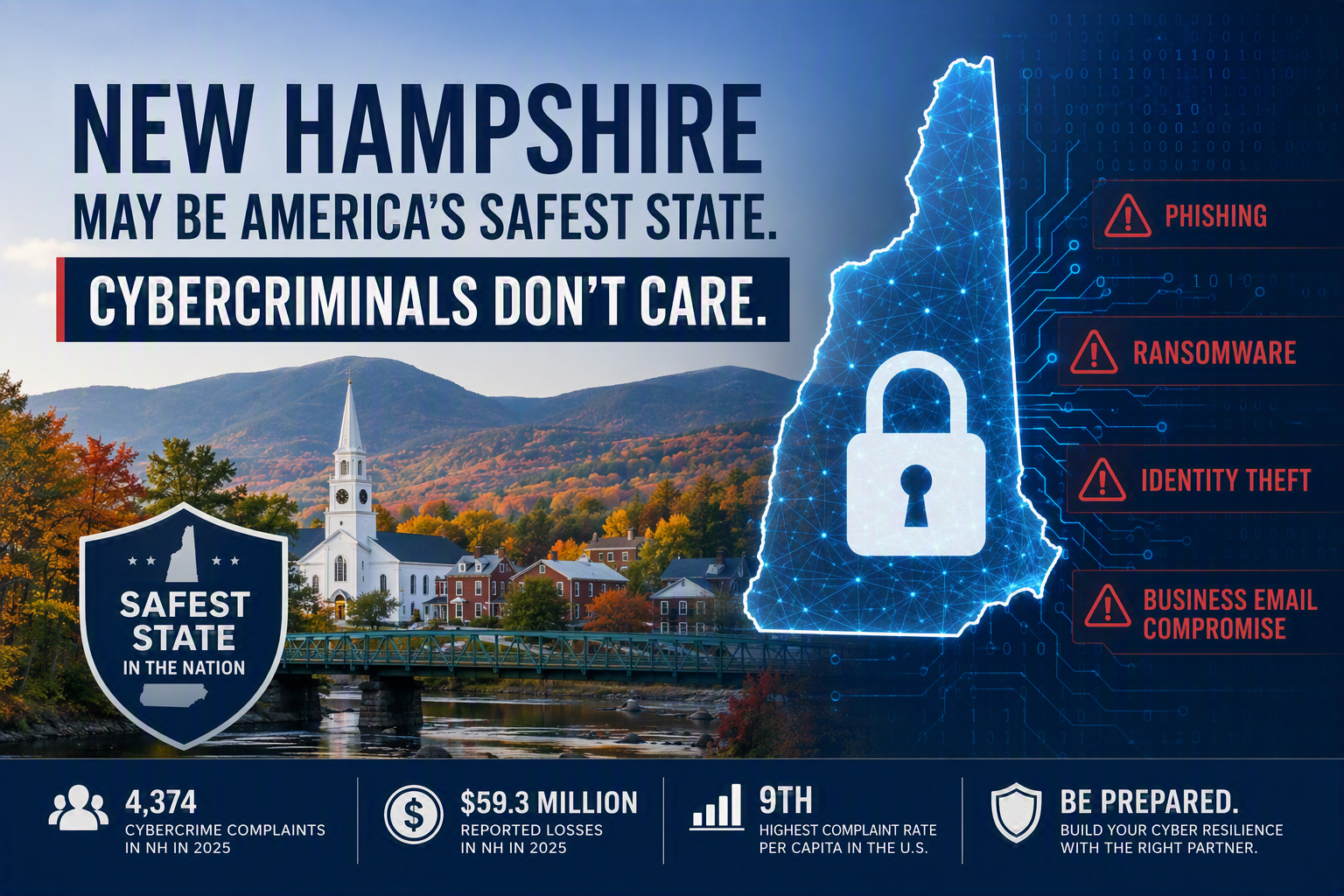
For the third consecutive year, New Hampshire has earned recognition as the safest state in America. Our communities enjoy low rates of violent crime, strong civic engagement, and a quality of life that is the envy of much of the country.
That's something worth celebrating.
But there is one type of crime where state borders, community safety rankings, and even rural geography provide little protection: cybercrime.
Unlike traditional criminals, cybercriminals don't need to be in Manchester, Portsmouth, Rochester, or Nashua to target your organization. They can operate from anywhere in the world, at any time, targeting businesses, municipalities, healthcare providers, schools, and nonprofits throughout New Hampshire.
And they're doing exactly that.
The Reality Behind the Numbers
According to the FBI's Internet Crime Complaint Center (IC3), New Hampshire residents reported 4,374 cybercrime complaints in 2025, resulting in more than $59.3 million in reported losses.
Even more surprising, New Hampshire ranked 9th in the nation for cybercrime complaints per capita, proving that being one of America's safest states doesn't make us immune to digital threats.
For perspective, cybercriminals stole more money from New Hampshire residents through online crime in a single year than many communities will lose to traditional property crimes combined.
Cybercrime Is Already Happening Here
Many business owners assume cyberattacks primarily target large metropolitan areas or Fortune 500 companies. Recent incidents across New Hampshire tell a different story.
One Vendor Breach Impacted Nearly One in Five Granite Staters
A breach involving technology services provider Conduent ultimately affected approximately 293,000 New Hampshire residents, according to reporting based on New Hampshire Attorney General filings.
Think about that for a moment.
Nearly one out of every five people in the state was potentially impacted by a cyber incident involving a third-party service provider they may have never heard of.
It's a powerful reminder that cyber risk extends beyond your own network. Today's businesses rely on dozens of vendors, cloud platforms, and service providers that can introduce risk outside your direct control.
Healthcare Organizations Were Also Impacted
Healthcare organizations continue to be attractive targets because of the sensitive information they store.
Recent breach notifications in New Hampshire included:
Coös County Family Health Services, which notified more than 35,000 New Hampshire residents
Cottage Hospital, which reported a data security incident ultimately affecting nearly 1,800 New Hampshire residents
These incidents involved highly sensitive information ranging from personal identification details to healthcare information, highlighting the value cybercriminals place on stolen data.
Higher Education Wasn't Immune Either
Even organizations with significant resources and security investments face risk.
Dartmouth College disclosed a cyber incident involving an Oracle software vulnerability that affected more than 31,000 New Hampshire residents.
The lesson isn't that these organizations failed.
The lesson is that cyber threats continue to evolve, and even mature institutions can become victims when attackers exploit software vulnerabilities or trusted third-party systems.
Local Governments Are Being Targeted Too
Cybercrime isn't only about stolen data.
It can disrupt critical services that communities rely on every day.
Over the past year, several New Hampshire municipalities and government organizations experienced cybersecurity incidents that affected operations and required systems to be taken offline while investigations took place.
Even when no data theft is confirmed, service outages, recovery costs, and operational disruptions can create significant challenges for residents and organizations alike.
In today's environment, cyber resilience is just as important as cybersecurity.
The Biggest Threat Is Often a Single Click
One of the most eye-opening findings from New Hampshire's Cyber Threat Assessment wasn't about ransomware or sophisticated hackers.
It was about people.
Of 63 cyber incidents reported through New Hampshire municipal risk-sharing programs, 61 began with a phishing email that resulted in compromised credentials.
That's a remarkable statistic.
Most cyber incidents didn't begin with advanced malware or a nation-state attack.
They started when someone clicked a link, entered credentials, or trusted a message that looked legitimate.
The report also found that Business Email Compromise (BEC) attacks contributed to more than $7 million in fraudulent financial transfers and losses among New Hampshire municipalities.
Why This Matters to New Hampshire Businesses
The safest state in America is still connected to the same internet as everyone else.
Cybercriminals don't care that your office is in a safe community. They care that:
You process payments
You store customer information
You rely on email
You use cloud applications
You have employees who receive hundreds of messages every week
Whether you're a manufacturer, nonprofit, healthcare provider, municipality, professional services firm, or local retailer, your organization is now part of a global digital ecosystem.
And that means you're a potential target.
The New Definition of Safety
For decades, safety meant locking doors, installing alarms, and protecting physical property.
Today, safety also means:
Multi-factor authentication
Security awareness training
Protected backups
Vulnerability management
Email security controls
Incident response planning
Vendor risk management
The organizations that recover most successfully from cyber incidents aren't necessarily the ones that never get attacked.
They're the ones that are prepared.
Final Thoughts
New Hampshire deserves its reputation as the safest state in the nation. But while crime rates may be low, cybercriminals operate without regard for geography, town size, or state rankings.
The evidence is clear. Millions of dollars are lost to cybercrime every year in New Hampshire. Healthcare providers, educational institutions, municipalities, and businesses continue to face attacks, breaches, and operational disruptions.
The good news?
Most organizations can dramatically reduce their risk through a combination of technology, employee awareness, and cybersecurity planning.
Because in today's world, being physically safe is no longer enough.
You have to be digitally resilient, too.