
Passkeys Aren't Broken. But They Aren't the Whole Security Strategy.
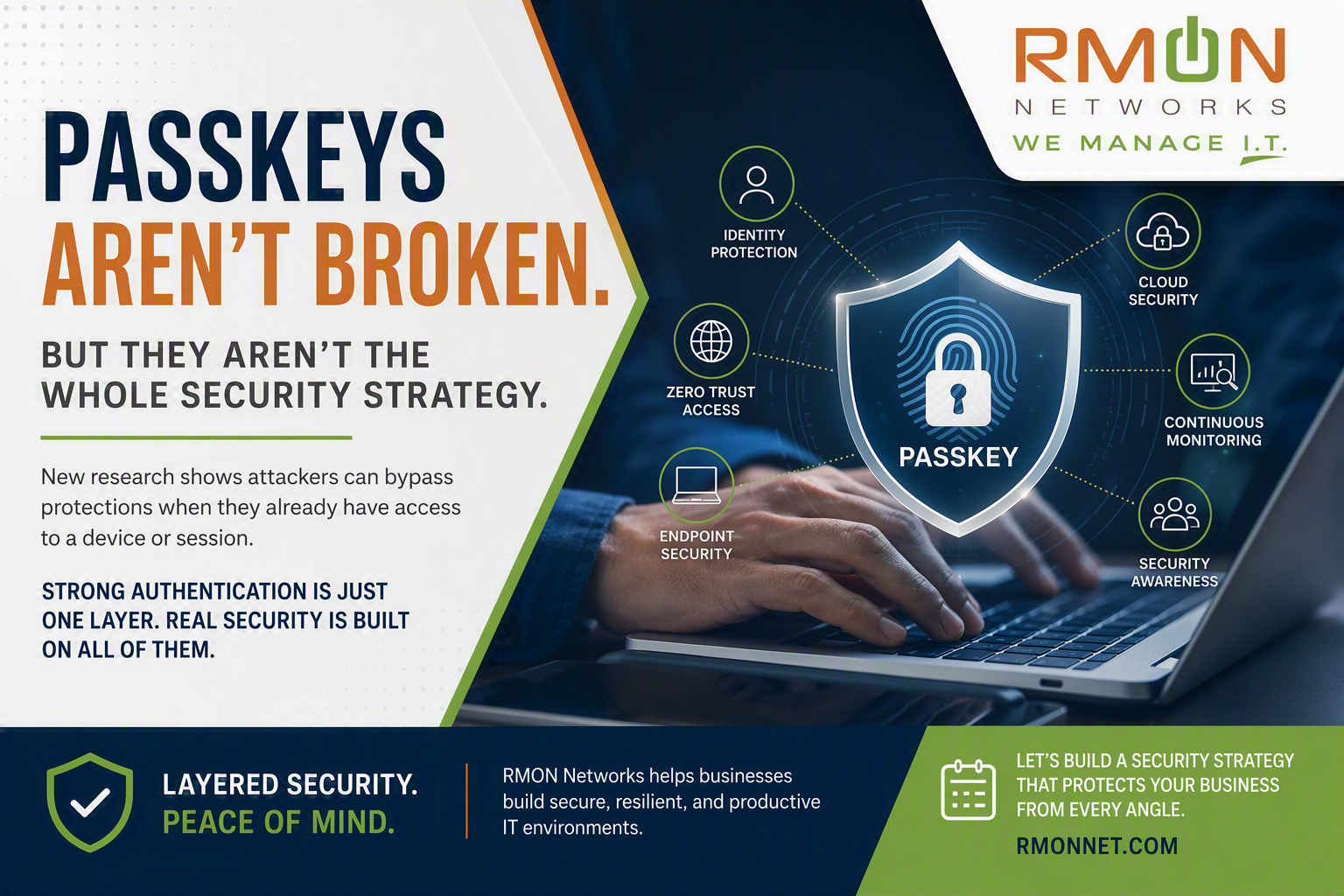
If you've seen recent cybersecurity headlines suggesting that passkeys can be bypassed, you may be wondering whether passwordless authentication is really as secure as experts claim.
The short answer: Yes, passkeys are still one of the strongest authentication methods available today.
However, new security research serves as an important reminder that no single cybersecurity tool can protect an organization from every threat. While passkeys significantly reduce the risk of phishing and credential theft, attackers continue to look for ways to exploit devices, applications, and user sessions once they gain access to a system.
For businesses, the lesson is not to abandon passkeys. The lesson is to adopt a comprehensive security strategy that protects identities, endpoints, and data together.
What Are Passkeys?
Passkeys are a passwordless authentication technology designed to replace traditional usernames and passwords.
Instead of relying on credentials that can be stolen, guessed, or reused, passkeys use cryptographic keys stored on a trusted device. This makes them highly resistant to phishing attacks and significantly more secure than standard passwords.
Major technology providers including Microsoft, Google, and Apple are investing heavily in passkey adoption because they reduce one of the most common causes of cyberattacks: compromised user credentials.
What Did Security Researchers Discover?
Recent research presented at Black Hat 2026 demonstrated several ways attackers could potentially misuse authentication processes without actually breaking the cryptography behind passkeys.
In every scenario, attackers first needed access to:
A compromised endpoint
Malware already running on a device
An active user session
Authentication data stored by software
Importantly, researchers did not crack or defeat the core cryptographic protection that makes passkeys secure. Instead, they found weaknesses in surrounding systems, configurations, and implementation details.
That distinction matters.
It's similar to finding a way into a building through an unlocked window rather than bypassing the front door's advanced security system.
The Real Business Takeaway
Many organizations think of cybersecurity as a single purchase:
"We deployed MFA, so we're protected."
"We moved to passkeys, so we're secure."
Unfortunately, cybercriminals don't see it that way.
Today's attackers target people, devices, applications, browsers, and cloud identity systems simultaneously.
That's why cybersecurity experts increasingly recommend a Zero Trust approach, where every user, device, and access request is continuously verified.
The reality is simple:
Strong authentication helps prevent attacks. Strong cybersecurity programs help contain them if they happen anyway.
Why Endpoint Security Matters More Than Ever
A key theme in the recent research is that some attack scenarios required malware or an already-compromised system.
That means endpoint protection remains one of the most important security investments businesses can make.
Modern endpoint security solutions provide:
Behavioral threat detection
Ransomware protection
Real-time monitoring
Automated threat response
Visibility into suspicious activity
Without endpoint security, businesses may not know an attacker has gained access until significant damage has already occurred.
Why Businesses Need a Layered Security Strategy
At RMON Networks, we often explain cybersecurity using the concept of layers.
Think of your business like a commercial building.
Passkeys are the access badges.
Endpoint security is the security guard.
Conditional Access is the locked door.
Security monitoring is the camera system.
Employee security awareness is the staff training.
Any one layer helps.
Together, they create a significantly stronger defense.
A modern cybersecurity strategy should include:
Passwordless Authentication
Passkeys and phishing-resistant MFA help reduce account compromise.
Endpoint Detection & Response (EDR)
Continuous monitoring helps detect advanced threats and suspicious activity.
Microsoft 365 Security Controls
Identity protection, Conditional Access, and secure configurations help reduce risk within cloud environments.
Zero Trust Security
Trust nothing automatically. Verify every access attempt.
Patch Management
Keeping operating systems, browsers, and applications updated helps eliminate known vulnerabilities.
Security Awareness Training
Employees remain a critical part of any successful security strategy.
The Growing Importance of Identity Security
Cybersecurity has increasingly become an identity problem.
Rather than attacking firewalls directly, criminals frequently target user accounts.
When attackers gain access to an employee identity, they may be able to:
Access sensitive files
Send fraudulent emails
Move laterally through systems
Deploy ransomware
Bypass traditional perimeter defenses
This is why identity security is becoming a core focus for organizations of all sizes.
Protecting user identities is no longer optional. It's a business requirement.
What RMON Recommends
For businesses looking to strengthen their cybersecurity posture, RMON recommends:
Enable passkeys where available
Deploy advanced endpoint protection
Implement Zero Trust security principles
Secure Microsoft 365 environments
Conduct regular vulnerability assessments
Review access permissions and privileged accounts
Invest in employee security awareness training
Maintain a documented incident response plan
Security is most effective when multiple controls work together.
In Summary
Passkeys represent a major advancement in authentication security and remain one of the strongest defenses against phishing and credential theft.
The recent research doesn't change that.
What it does reinforce is a lesson cybersecurity professionals have been teaching for years:
There is no silver bullet in cybersecurity.
Businesses that combine strong authentication, endpoint protection, security monitoring, user education, and Zero Trust principles are far better prepared to defend against today's evolving threats.
At RMON Networks, we help organizations build layered security strategies that reduce risk, improve compliance, and protect business operations.
Ready to Evaluate Your Security Posture?
Don't wait for an incident to identify security gaps.
Contact RMON Networks today for a cybersecurity assessment and learn how a layered security approach can help protect your business against modern cyber threats.