
Preparing for 2027: Don’t Let Renewals Become Your Technology Strategy
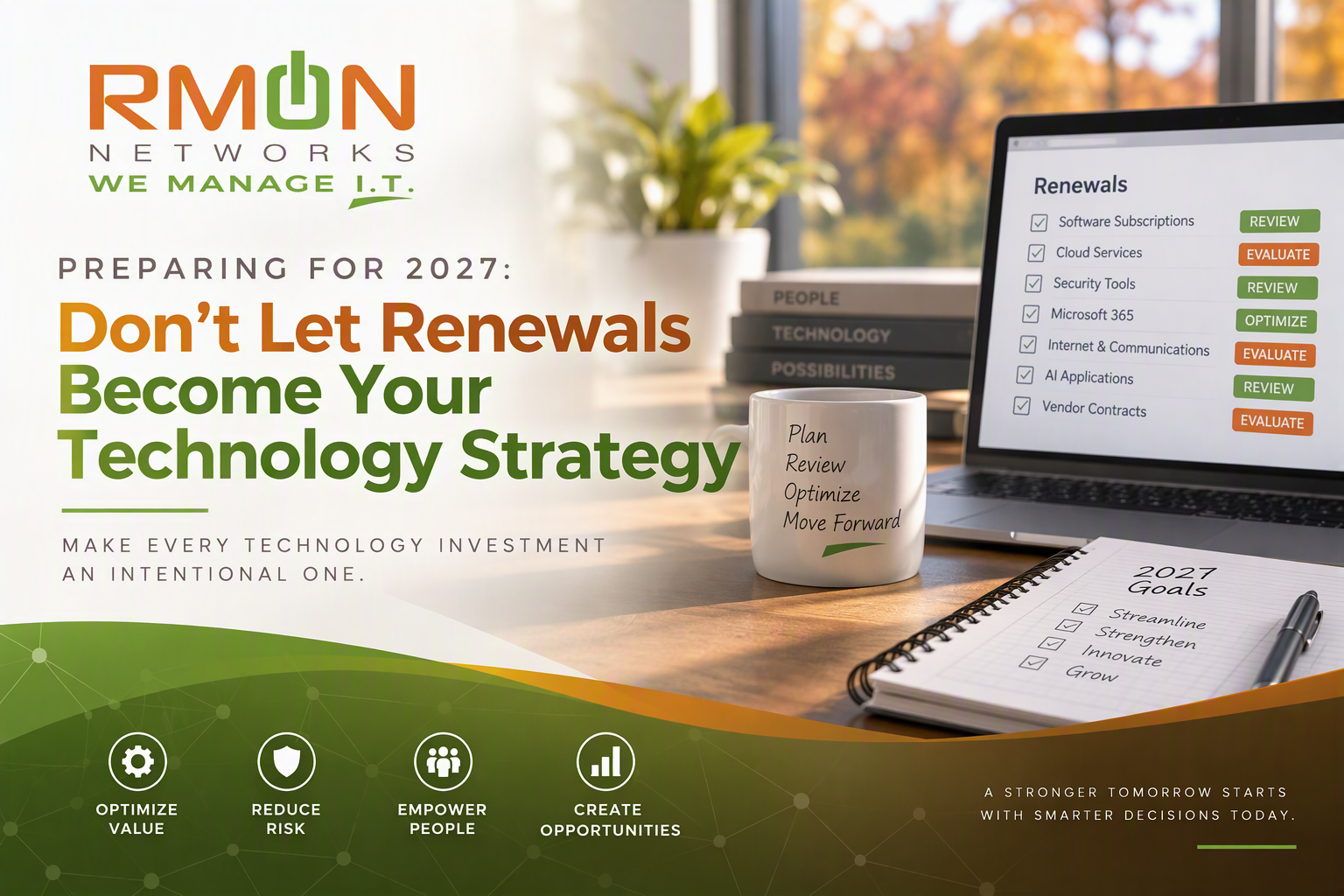
As 2026 winds down, many businesses are beginning to build budgets and set priorities for 2027.
But there’s one part of next year’s technology budget that may already be making decisions for you: renewals.
Software subscriptions. Microsoft licenses. Cloud services. Security tools. Internet and communications services. Vendor contracts. AI applications.
One renewal arrives. The invoice looks familiar. The service is still being used. Nobody has raised a concern.
So it gets approved.
Then another comes in. And another.
Before long, a significant portion of your 2027 technology budget has been committed, not because each investment was reviewed and deliberately chosen, but because it was already there.
That's how renewals can quietly become your technology strategy.
And as you prepare for 2027, it's a good time to step back and ask whether everything you're renewing still deserves a place in where your business is headed.
Renewal Should Be a Decision, Not a Default
Most businesses don't set out to accumulate unnecessary technology.
It happens gradually.
A new application solves an immediate problem. A department adds a cloud service. More licenses are purchased as the company grows. A security solution is introduced to address a new risk. Another platform gets added because it offers a feature someone needs.
Each decision can make perfect sense at the time.
But businesses change.
Your people change. Your processes change. Technology changes. And increasingly, the capabilities included in the platforms you already own change.
The problem is that businesses often spend far more time deciding what technology to add than deciding whether existing technology still makes sense.
That's why a renewal shouldn't simply trigger the question:
"Are we still using this?"
It should trigger a better one:
"If we were making this technology decision today, would we still make the same choice?"
That small change in perspective can lead to a very different conversation.
Usage Doesn't Always Equal Value
Simply using something doesn't necessarily mean you're getting the right value from it.
Maybe employees are using only a fraction of its capabilities.
Perhaps another platform the company already owns now provides similar functionality.
The number of employees who actually need the application may have changed.
Or perhaps the business has simply outgrown the solution.
Before renewing, look beyond whether the technology is being used.
Ask:
What business problem is this solving today?
Are we getting the value we're paying for?
Has something we already own made this redundant?
Would we choose this same solution if we were starting today?
That's a much better measure of whether something deserves a place in your 2027 budget.
Look for the Overlap You Didn't Intentionally Create
Technology environments tend to grow one solution at a time.
That's how businesses can eventually find themselves paying for multiple tools that accomplish similar things.
File sharing. Video meetings. Collaboration. Password management. Project management. Electronic signatures. Backup. Security. Reporting. Automation. AI.
There may be perfectly good reasons to keep overlapping solutions.
The important question is whether that overlap is intentional.
If you're paying for three platforms that perform similar functions and nobody can clearly explain why all three are necessary, there's probably a conversation worth having before the next renewal date.
Make Sure You're Paying for the Right People, Too
A renewal review isn't just about which products you use.
It's also about how much of each product you're buying.
Think about how much changes in a year:
Employees leave. New people are hired. Responsibilities change. Contractors come and go. Departments expand or consolidate.
Licensing doesn't always keep up.
Before committing to another year, review:
How many licenses you're paying for
How many are actually assigned
Whether those licenses are actively being used
Whether employees have the appropriate license level
Whether premium features you're paying for are actually being used
This isn't particularly exciting technology strategy.
But it is smart business management.
And the dollars identified here can potentially be redirected toward initiatives that matter more in 2027.
Don't Confuse Cutting Costs With Optimizing Technology
This distinction is important.
The goal of a technology review shouldn't be
"What can we eliminate?"
It should be:
"Are we investing in the right things?"
Cybersecurity is a good example.
A security service might look like another recurring expense on a spreadsheet, but removing it without understanding the role it plays could introduce significantly more risk than the savings justify.
The same applies to backup, monitoring, business continuity and other technologies whose value becomes most visible when something goes wrong.
Sometimes the right answer after a review is:
Keep it. It's doing exactly what we need it to do.
That's still a successful review.
You've made an intentional business decision instead of allowing an automatic renewal to make the decision for you.
AI Makes the 2027 Conversation Even More Important
There's also a relatively new category beginning to appear on company credit cards and technology budgets: AI.
Employees and departments are experimenting with AI tools for writing, meetings, research, design, productivity and automation.
Some of those tools can create real value.
But without visibility, businesses can quickly find themselves with multiple AI subscriptions, overlapping capabilities and employees sharing company information with platforms the organization hasn't evaluated.
As you prepare for 2027, this is a good opportunity to move beyond:
"We're experimenting with AI."
toward:
"We understand where AI can create value for our business, which tools we want to use and how we'll use them responsibly."
That's where experimentation starts becoming strategy.
Turn 2027 Renewal Season Into Review Season
You don't need to make this complicated.
For every significant technology renewal coming up in the next 6 to 12 months, evaluate four things:
VALUE
What business problem is this solving for us?
USAGE
Are we actually using what we're paying for?
OVERLAP
Do we already have another technology that can do the same thing?
RISK
What would change if we reduced, replaced or eliminated it?
Then add one final question:
FIT
Does this investment support where we're trying to take the business in 2027?
That last question is where a renewal conversation becomes a strategy conversation.
Make Room in 2027 for What's Next
There’s another reason this matters.
Every dollar automatically committed to a technology decision made two or three years ago is a dollar that isn't available for a newer technology priority.
Maybe 2027 is the year you improve cybersecurity.
Replace aging infrastructure.
Automate a cumbersome process.
Improve the employee experience.
Get more from Microsoft 365.
Develop an AI strategy.
Or invest in technology that supports a new business opportunity.
Preparing for 2027 shouldn't simply mean determining how much your existing technology will cost next year.
It should mean deciding:
What technology will our business actually need to accomplish what we're trying to do next?
Don't Let Yesterday's Decisions Build Tomorrow's Technology Strategy
The objective isn't necessarily to spend less on technology in 2027.
It's to spend more intentionally.
Know what you're paying for.
Understand what value it's delivering.
Eliminate unnecessary overlap.
Understand the risks before making changes.
And make room for investments that support where your business is going next.
As you begin preparing for 2027, take a look at what's scheduled to renew during the next 6 to 12 months.
Then ask one simple question:
If we were building our technology environment today, would we make the same choices?
Some answers will be yes.
Others may surprise you.
Those are exactly the conversations worth having before another renewal notice arrives.
Prepare for 2027 With a Plan, Not a Collection of Renewals
At RMON Networks, we believe technology planning should start with understanding your business, what you already have, what's delivering value, where unnecessary overlap exists and where new investments could take you next.
Because a good technology strategy isn't about having more technology.
It's about having the right technology for where your business is going.