Preparing for 2027: Why Your Next Business PC Should Be Built for AI
For years, buying a new business PC was fairly straightforward. You looked at the processor, memory, storage, screen size, and price, then chose something that could comfortably run your applications.
Moving into 2027, that conversation is changing.
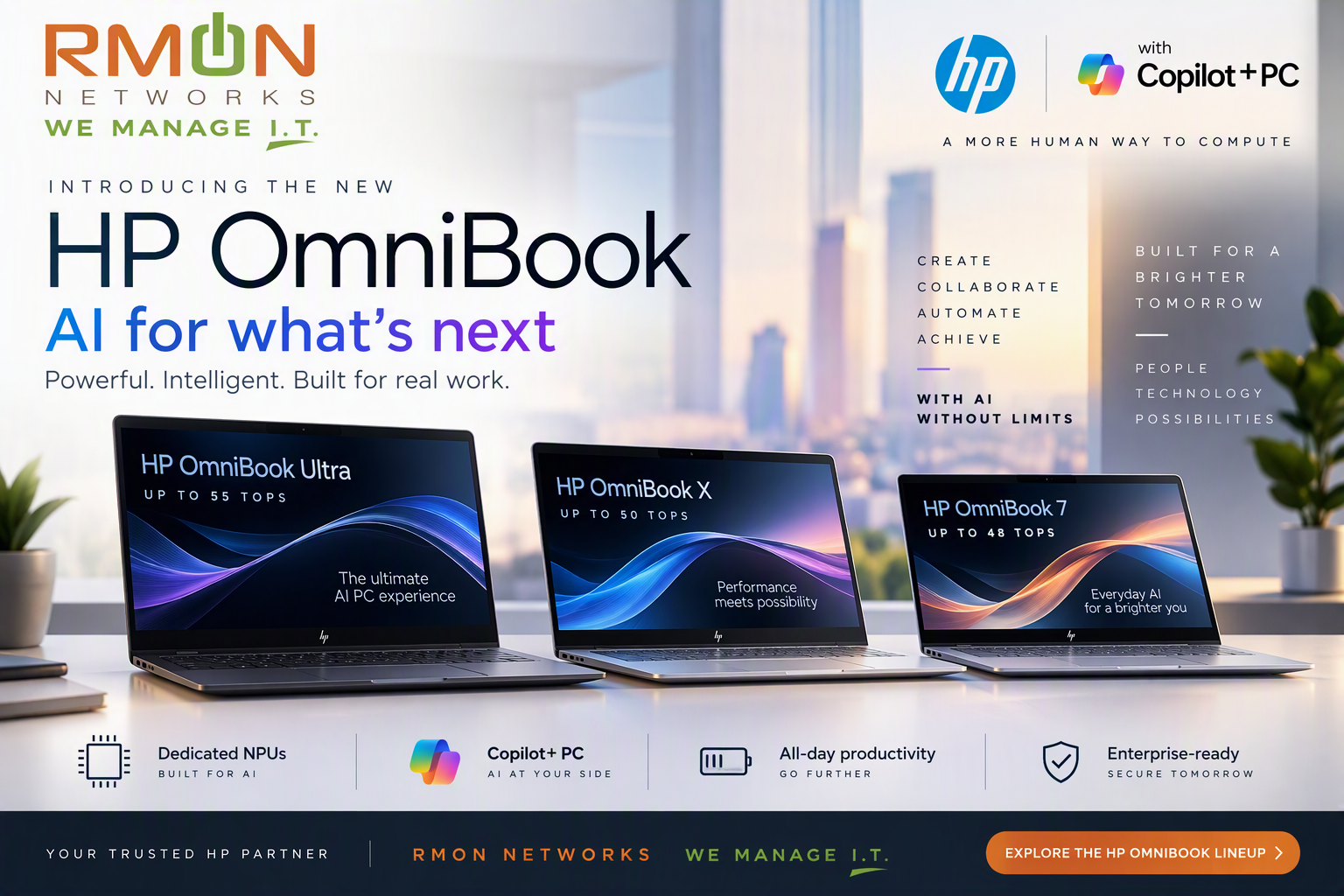
AI is becoming part of everyday business software, and that means the PC itself has a bigger role to play. HP’s OmniBook lineup represents this new generation of AI-ready PCs, with models such as the OmniBook Ultra, OmniBook X, and OmniBook 7 designed around dedicated AI processing.
For small and midsize businesses, however, the real question isn’t:
“Do we need an AI PC?”
It’s:
“If we're replacing computers anyway, should we invest in devices designed for where business technology is going next?”
Increasingly, the answer may be yes.
The PC Is Becoming Part of Your AI Strategy
Most businesses think about AI in terms of software: Microsoft Copilot, automation tools, meeting assistants, analytics, and AI-enabled applications.
But there is another part of the equation: the device employees use every day.
Traditional computers rely primarily on the CPU and GPU for processing. Newer AI PCs add an NPU, or Neural Processing Unit, specifically designed to handle AI-related workloads.
Think of it as adding a specialized engine to the computer.
Instead of asking the main processor to handle everything, certain AI workloads can be directed to hardware designed specifically for that type of processing.
That distinction matters as more business applications incorporate AI.
What Does That Mean for an SMB?
The value isn't necessarily one dramatic new feature. It is about preparing the technology employees use every day for a workplace where AI will increasingly be integrated into normal business processes.
1. Create a Better Foundation for AI
Many SMBs are still figuring out exactly how AI will fit into their businesses.
That is okay.
You don't need a complete three-year AI strategy before purchasing your next laptop.
But if you are replacing PCs in 2027, buying devices designed to support emerging AI workloads can reduce the risk of investing in hardware that feels outdated earlier than expected.
The important distinction is AI-ready rather than AI-dependent.
An employee can still use the computer like any other business PC today, while the organization has a stronger platform for adopting AI capabilities as useful business cases emerge.
2. Put AI Closer to the Employee
Cloud computing isn't going away. But not every AI capability necessarily needs to depend entirely on processing somewhere else.
The dedicated NPU in an AI PC enables supported workloads to take advantage of AI processing on the device.
For the user, the underlying technology isn't really the point.
The potential business value is.
As applications evolve, employees may increasingly encounter AI helping with activities surrounding communication, collaboration, content creation, search, meetings, and everyday productivity.
The PC becomes an active participant in that experience rather than simply the screen used to access it.
3. Give Microsoft 365 Investments Room to Grow
Many SMBs have already invested heavily in Microsoft 365.
The next phase isn't simply adding another application. It is figuring out how AI can make the tools employees already use more valuable.
That makes the endpoint worth considering when planning a broader Microsoft and AI strategy.
Instead of looking at PCs, Microsoft 365, security, and AI as four separate purchasing decisions, businesses can start treating them as parts of the same technology roadmap.
That is a much more strategic way to approach technology spending.
4. Modernize While You're Already Replacing Equipment
This may be the most practical argument of all.
SMBs don't replace every computer because a new technology appears. Nor should they.
A better approach is to modernize naturally.
When a three-, four-, or five-year-old laptop is due for replacement, ask whether replacing it with another conventional system provides the best long-term value or whether an AI-ready device makes more sense.
That turns AI adoption into an evolution rather than a forklift upgrade.
Over several replacement cycles, the business gradually develops a newer fleet capable of supporting the next generation of applications.
5. Productivity Gains Don't Need to Be Dramatic to Matter
When people hear “AI transformation,” they sometimes imagine enormous automation projects.
For many SMBs, the better opportunity is much smaller.
What if technology could eventually save an employee a few minutes preparing for a meeting?
Help someone get through a routine administrative task faster?
Make information easier to find?
Reduce repetitive work?
Help turn an idea into a first draft more quickly?
Those improvements sound modest individually. Across dozens of employees performing hundreds of tasks every week, small improvements can become meaningful.
That is where AI may provide some of its greatest value to SMBs: removing friction from everyday work.
Where HP OmniBook Fits
HP's OmniBook family offers several ways to enter this new generation of AI PCs.
The lineup discussed here includes:
HP OmniBook Ultra, positioned at up to 55 TOPS
HP OmniBook X, positioned at up to 50 TOPS
HP OmniBook 7, positioned at up to 48 TOPS
Each incorporates a dedicated NPU and is intended to support the emerging AI-PC experience.
For an SMB, however, the highest number isn't automatically the right choice.
The better question is:
What does this employee actually need to accomplish?
A company may have different requirements for executives, salespeople, office employees, power users, and employees who spend most of the day working in cloud applications.
Standardizing around a small number of properly selected configurations can often be more valuable than simply purchasing the highest-specification computer for everyone.
Don't Let AI Become Another Reason to Overspend
There's an important flip side to this conversation.
“AI PC” shouldn't become the 2027 version of buying technology simply because it is new.
A computer should still be selected around the person using it, the applications they need, security requirements, expected lifespan, manageability, warranty, and total cost.
AI capability becomes another consideration in that decision, not the only consideration.
The objective isn't to put the fanciest laptop on every desk.
It's to make sure the technology you're buying today doesn't unnecessarily limit what your employees can do tomorrow.
A Better Question for Your 2027 Technology Budget
As you plan for 2027, take a look at your PC replacement schedule alongside your Microsoft 365, cybersecurity, and AI plans.
Ask:
Which computers are nearing the end of their useful lifecycle?
Where are employees experiencing performance or productivity problems?
Which roles are the strongest candidates for AI-enabled workflows?
Are we planning hardware purchases and our AI strategy separately when they should be connected?
Could standardizing around newer AI-ready devices simplify our technology roadmap?
Are we buying PCs simply because existing warranties or leases are expiring, or because the new equipment supports where the business is going?
Those questions move the conversation from “What laptop should we buy?” to “What should our employees' technology experience look like over the next several years?”
And that's the more important discussion.
The Bottom Line
The move toward AI PCs doesn't mean every SMB needs to replace its computers tomorrow.
It does mean businesses should start thinking differently about the computers they purchase next.
If employees are already due for device replacements, HP OmniBook AI PCs offer an opportunity to combine normal PC lifecycle planning with preparation for a more AI-enabled workplace.
Don't replace yesterday's PC with another PC designed for yesterday.
Use the 2027 refresh cycle as an opportunity to build a technology foundation that can grow with your employees, your Microsoft investment, and your approach to AI.
At RMON Networks, that's how we believe technology planning should work: not chasing every new trend, but making thoughtful investments today that give your business more options tomorrow.