
The New Economics of AI: What Microsoft's Copilot Billing Changes Mean for Businesses
Artificial intelligence is quickly becoming a standard business tool rather than an experimental technology. As organizations move beyond simply testing AI and begin deploying it across teams, Microsoft's approach to billing is evolving as well.
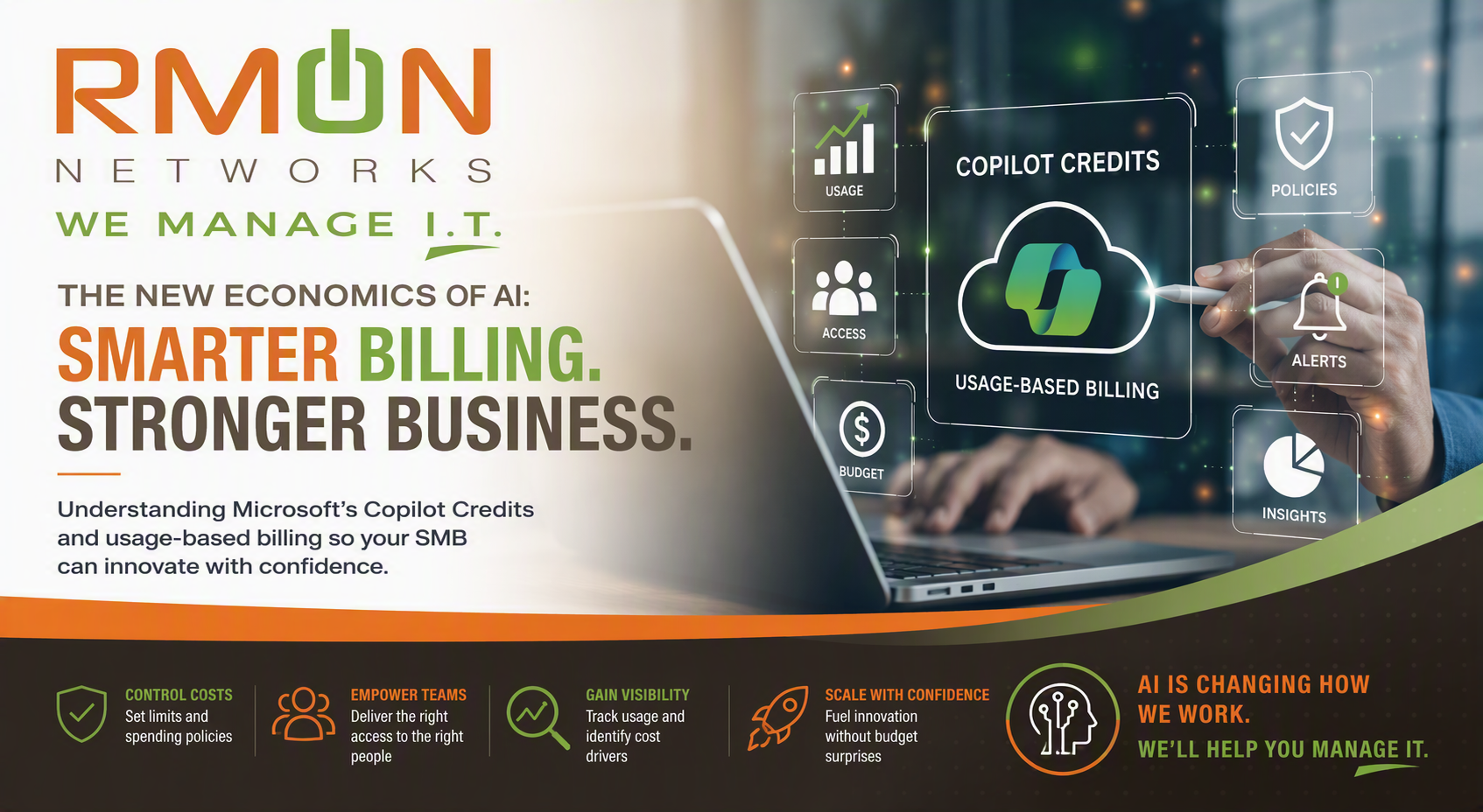
Microsoft recently expanded its usage-based billing framework for certain Copilot services, introducing Copilot Credits as a consumption-based model that allows organizations to pay based on actual usage rather than relying solely on fixed licensing. Supported services include Cowork, applications built with Cowork, and the Work IQ API. Organizations can use prepaid credits, pay-as-you-go billing, or a combination of both while managing access, spending policies, and usage through the Microsoft 365 Admin Center. Usage-Based Billing and Cost Management for Copilot Credits
For small and midsize businesses, this shift represents both an opportunity and a new financial planning challenge.
The Move from Seats to Consumption
Historically, IT budgets have been relatively easy to forecast. Licenses were purchased on a per-user basis, and costs remained fairly predictable throughout the year.
AI introduces a different model.
Instead of paying only for access, businesses may now be paying for usage. The more employees leverage AI-driven services, agents, and APIs, the more credits are consumed. Microsoft's Cost Management dashboard enables administrators to monitor usage, establish spending policies, set limits, and review consumption trends across users, groups, services, and agents. Usage-Based Billing and Cost Management for Copilot Credits.
This approach creates flexibility, but without planning, it can also introduce budget uncertainty.
Why SMBs Should Pay Attention Now
The reality is that many organizations are still learning how employees will use AI.
A salesperson may use Copilot to build proposals and summarize meetings. A marketing team might leverage AI to develop content and campaigns. Engineers could utilize AI-assisted research, documentation, and troubleshooting. Customer success teams may use it to improve client communications and knowledge management.
When AI adoption expands organically across departments, consumption can increase significantly faster than expected.
That's why budgeting for AI requires a different mindset than budgeting for traditional software licenses.
Instead of asking, "How many users do we have?" organizations should start asking:
Which teams are using AI most heavily?
Which use cases generate measurable business value?
How much consumption is predictable versus experimental?
What guardrails should be put in place?
Microsoft's usage-based billing controls were designed specifically to help answer these questions by providing visibility into consumption patterns and spending. Usage-Based Billing and Cost Management for Copilot Credits
Understanding Your Billing Options
Microsoft currently supports two primary approaches:
Prepaid Credits
With prepaid credits, organizations purchase usage capacity in advance.
Benefits include:
Greater budget predictability
Easier forecasting
Reduced risk of unexpected spending
Simpler financial governance
Prepaid models are often ideal for business users whose workloads are relatively stable and predictable.
Pay-As-You-Go
Pay-as-you-go billing charges organizations based on actual consumption.
Benefits include:
Greater flexibility
Easier scaling
No risk of running out of purchased capacity
Better support for pilot programs and innovation projects
Pay-as-you-go is typically well suited for AI experimentation, custom agent development, and rapidly changing workloads. Usage-Based Billing and Cost Management for Copilot Credits
Why Most SMBs Should Consider a Hybrid Approach
After evaluating Microsoft's billing models and working through planning scenarios, we believe many SMBs will benefit from a hybrid strategy.
A practical approach might look like this:
Prepaid Capacity for:
Leadership teams
Sales teams
Customer service teams
Operations staff
Administrative users
Pay-As-You-Go for:
AI development projects
Custom AI agents
API integrations
Innovation initiatives
Pilot programs
This structure provides financial predictability where usage is established while preserving flexibility for innovation.
Think of it as budgeting for both "run the business" and "grow the business" activities.
Four Steps SMBs Should Take Today
1. Establish an AI Budget
Many organizations have detailed technology budgets but no dedicated AI budget.
Creating a separate AI spending category improves visibility, forecasting, and accountability.
2. Implement Spending Policies
Don't wait until costs become a concern.
Microsoft's Cost Management capabilities allow administrators to create spending policies, define user limits, establish alerts, and manage access from a centralized location. Usage-Based Billing and Cost Management for Copilot Credits
3. Track Budget Versus Actual Usage
Organizations should monitor:
Monthly AI spending
Department-level consumption
Budget variance
High-consumption users
Emerging usage trends
Even simple monthly reviews can reveal opportunities to optimize costs and improve adoption.
4. Include a Contingency Reserve
AI adoption rarely follows a perfectly predictable path.
Many organizations are finding success by including a contingency reserve in their AI budgets to account for new use cases, expanded adoption, and unexpected consumption increases.
A modest reserve helps avoid budget disruptions while supporting innovation.
The Bigger Opportunity
It's easy to focus on the cost side of AI, but the more important question is value.
Organizations that approach AI strategically are already seeing improvements in productivity, employee efficiency, knowledge sharing, customer responsiveness, and decision-making.
The goal isn't merely to manage spending.
The goal is to create enough visibility and governance so your organization can confidently scale AI where it delivers meaningful business outcomes.
Microsoft's evolving billing model reflects a broader shift across the technology industry: organizations are increasingly paying for outcomes and consumption rather than simply licenses and access.
For SMBs, the winners will be the companies that balance innovation with governance, combining strong financial controls with a clear vision for how AI can transform their business.
Final Thoughts
The transition to usage-based AI billing may feel unfamiliar at first, but it represents an important step toward aligning technology investments with actual business value.
Organizations that establish budgets, monitor consumption, implement governance policies, and adopt a balanced billing strategy will be far better positioned to maximize the return on their AI investments.
At RMON Networks, we're helping organizations evaluate AI readiness, establish governance frameworks, and build practical consumption strategies that make AI adoption both sustainable and measurable.
The future of AI isn't just about using the technology. It's about using it responsibly, effectively, and with a clear understanding of both cost and value.