
Why Resilience Has Become a Leadership Issue, Not Just an IT Issue
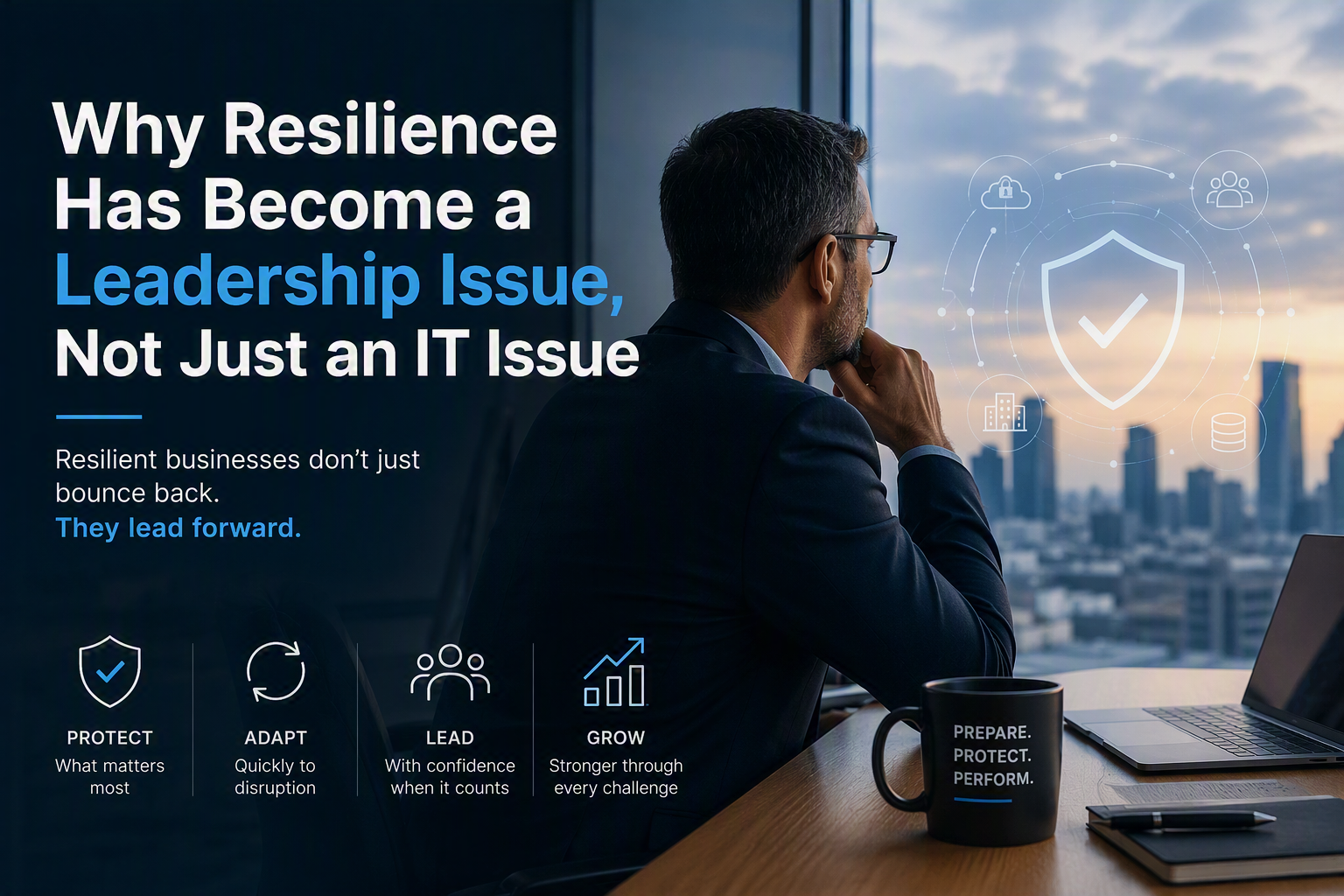
Over the past year, I've been having a different kind of conversation with business leaders.
Not about firewalls. Not about cloud migrations. Not even about cybersecurity.
The discussion increasingly centers on something much broader: resilience.
For many small and mid-sized businesses, resilience was once viewed as an IT responsibility. If systems were up and running, backups were in place, and employees could access their applications, the assumption was that the business was resilient.
Today, that definition falls short.
The reality is that resilience has become a leadership issue because technology now sits at the center of nearly every business function. When systems are unavailable, workflows stop. When communication platforms fail, decision-making slows. When a cyberattack disrupts operations, it doesn't just create an IT problem. It creates a business problem.
And that's what we're seeing more often across the SMB market.
The organizations navigating disruption most effectively aren't necessarily the ones spending the most on technology. They're the ones whose leadership teams have broadened their view of risk. They've recognized that resilience is not about preventing every challenge. It's about ensuring the business can continue to operate when challenges inevitably occur.
Think about the events that can interrupt business today:
A cyberattack that encrypts critical data
An unexpected internet outage
A key software platform becoming unavailable
A supply chain disruption
A severe weather event
An employee accidentally exposing sensitive information
None of these scenarios start as leadership issues. But all of them quickly become leadership issues when customers are affected, revenue is delayed, or employees can't do their jobs.
The strongest organizations are asking different questions than they were five years ago.
Instead of asking, "Are we protected?"
They're asking:
"How would we communicate with customers?"
"What happens if our team can't access critical data tomorrow morning?"
"Do we know the financial impact of 24 hours of downtime?"
These are strategic questions, not technical ones.
Resilient businesses understand that technology is no longer simply supporting operations. In many cases, technology is the operation. Sales, customer service, finance, communications, and productivity all depend on it.
That's why resilience planning deserves a seat at the leadership table.
One trend we're observing among successful SMBs is that they're becoming more proactive. They're moving away from the mindset of "We'll deal with it if it happens" and toward "Let's understand the impact before it happens."
That shift changes everything.
When leaders have visibility into their operational risks, they can make smarter decisions about investments, staffing, processes, and security. They can prioritize the areas that would have the greatest impact on business continuity instead of simply reacting when something goes wrong.
The goal isn't perfection. The goal is confidence. Confidence that your team can continue serving customers. Confidence that critical data is protected. Confidence that disruptions, while inevitable, don't have to become disasters.
As business leaders, we often focus on growth, innovation, and opportunity. Those priorities matter. But resilience is what protects all three. Without it, even the best growth strategy can be derailed by a single unexpected event.
The organizations that thrive over the next several years won't be the ones that avoid every challenge. They'll be the ones that are prepared to adapt, recover, and move forward when challenges arise.
That's why resilience is no longer just an IT conversation. It's a leadership conversation. Increasingly, it's becoming one of the most important conversations that businesses have.
Question to Consider: If one critical system your business depends on became unavailable tomorrow, how quickly could your organization continue operating normally? The answer may tell you more about your resilience than any technology assessment ever could.
If you're like most SMB leaders, your days are focused on growth, customer relationships, employee engagement, and keeping operations moving forward. Resilience planning often gets pushed down the priority list because everything seems to be working today.
But resilience isn't tested on the good days.
The best time to evaluate how your business would respond to disruption is before disruption occurs.
Take 30 minutes with your leadership team this month and ask a few simple questions:
What systems can we not operate without?
How long could we function if those systems became unavailable?
What would be the financial impact of a day of downtime?
Who owns our response plan if a cyber incident or operational disruption occurs?
Are we confident we could continue serving customers during an unexpected outage?
The answers may uncover risks you didn't realize existed, but they'll also create opportunities to strengthen your business before those risks become reality.
At RMON Networks, we believe resilience starts with visibility. The organizations that recover fastest aren't necessarily the largest or most sophisticated. They're the ones that have taken the time to understand what matters most and put a plan in place to protect it.
Don't wait for an outage, cyberattack, or business interruption to reveal where your vulnerabilities are. Start the conversation now. Your future customers, employees, and business will thank you for it.